
Why You Don't Know Why You're Winning or Losing Deals
- Elizabeth Christopher
- 3 days ago
- 5 min read
Every quarter, revenue leaders review win-loss reports and make strategic decisions based on CRM data. The uncomfortable truth is that most companies still don’t know why they’re winning or losing deals, even the ones they believe they should have won. The data they rely on is wrong far more often than they realize, and wrong in ways that produce confident but incorrect strategic decisions.
The Confidence Problem
Most B2B revenue leaders do not believe they are flying blind on deal intelligence. They have CRM data. They run pipeline reviews. Some conduct post-mortems. A few even have formal win-loss programs. The data exists. The reports get built. The conclusions feel reasonable.
That confidence is the problem.
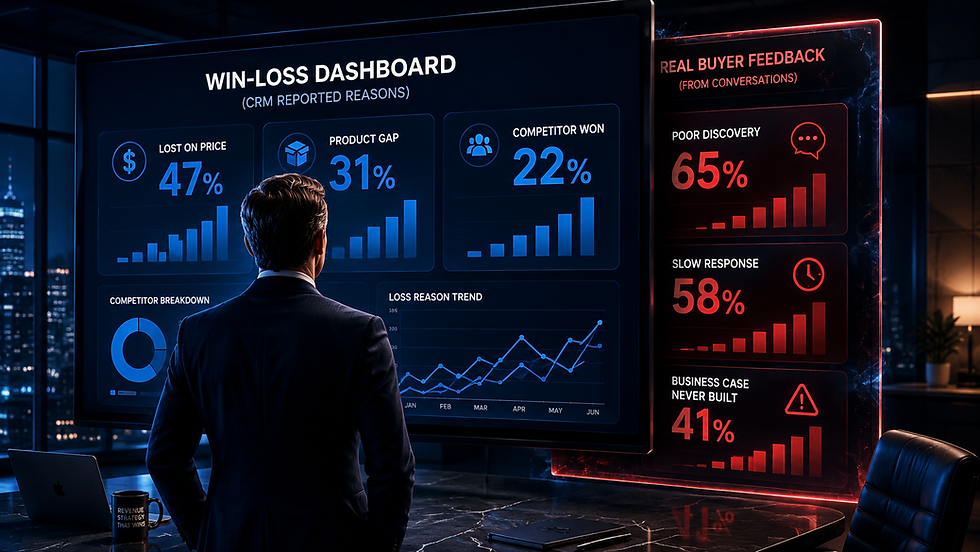
Clozd's analysis of thousands of B2B deals, cited by Prospeo's 2026 win-loss research, found that the closed-lost reason entered in CRM is wrong 85% of the time. The competitor listed as the reason for the loss is wrong 65% of the time.
This is not a finding about companies that do not track win-loss data. It is a finding about companies that do, and believe the data is telling them something true.
Why You Don't Know Why You're Losing Deals
To understand why the data is wrong, you have to understand who enters it and why.
When a deal is lost, a sales rep closes it in the CRM. They select a loss reason from a dropdown. The most common choices look familiar: lost on price, product gap, competitor won, timing not right, decision already made.
These answers share a common characteristic: they attribute the loss to factors outside the rep's control. Price is a company decision. Product gaps are a product team problem. A competitor winning is market dynamics. None of these implicate the rep's discovery quality, their follow-up speed, their ability to build urgency, or their failure to engage the right stakeholders.
This is not dishonesty. It is human nature inside a poorly designed system. Reps are not maliciously falsifying records. They are selecting the available answer that explains the loss without creating accountability for their own role in it. The CRM provides the dropdown. The dropdown enables the narrative. The narrative becomes the data. And then leadership uses that data to set strategy.
The Buyer's Account Is Completely Different
What happens when buyers are asked directly, not through a CRM field but through an actual conversation?
Corporate Visions' research based on over 100,000 B2B purchase decisions, cited by Prospeo, found that sellers and buyers cite completely different reasons for lost deals 50 to 70% of the time. Sellers report price and product gaps. Buyers cite poor needs discovery, lack of differentiation, and slow response times.
The seller and the buyer experienced the same sales process and produced fundamentally different accounts of why it failed. The seller's account enters the CRM. The buyer's account goes nowhere.
The divergence is not marginal. In more than half of deals, the story the revenue team is telling itself about why it lost bears no meaningful relationship to what the buyer actually experienced.
1 in 10 deals marked as lost in the CRM had a buyer who was still actively considering the vendor at the time the record was closed. Revenue being written off while the buyer was still deciding. Deals abandoned before the buyer had finished evaluating.
The same distortion affects wins. Deals are frequently marked as wins because of product superiority, pricing, or competitive positioning when buyers cite entirely different reasons. Companies often repeat successful tactics for the wrong reasons, creating as much strategic risk from misunderstood wins as from misunderstood losses.
The Structural Failure of Win-Loss Analysis
Some companies attempt to correct for CRM inaccuracy through formal win-loss programs: post-deal interviews, buyer surveys, structured debrief processes. The intention is right. The methodology is usually flawed.
The first structural problem is timing. Post-deal interviews are conducted weeks or months after the buyer made their decision. Memory fades. Buyer context changes. The specific objections, criteria, and dynamics that determined the outcome are no longer fresh, and buyers, who want to preserve vendor relationships and avoid uncomfortable conversations, tend to give polite rather than accurate retrospective answers.
The second structural problem is coverage. Prospeo's 2026 analysis found that 63% of B2B losses happen before a proposal is ever sent, at discovery and qualification stages. Most win-loss programs focus on deals that reached late stages. The majority of losses happen earlier and quieter, in conversations that felt fine to the rep but failed to create the clarity and urgency the buyer needed to move forward. Those early-stage losses rarely make it into formal win-loss analysis at all.
The third structural problem is sample size. Most win-loss programs analyze a small fraction of deals, enough to generate a report, not enough to identify statistically reliable patterns. The conclusions drawn from a handful of interviews get applied to the entire market.
The result is a win-loss program that looks rigorous and produces inaccurate intelligence.
What False Intelligence Costs Strategically
This is where the compounding damage becomes visible.
When pricing strategy adjusts based on "lost on price" data that is wrong 85% of the time, the price change solves a problem that did not exist. Revenue margin is sacrificed to address a buyer concern that was never actually the barrier.
When product roadmap priorities are set based on "product gap" loss reasons that buyers did not cite, development resources go toward features that were never the real decision criteria. The product gets built. The win rate does not improve. The strategic hypothesis was wrong from the start.
When competitive response is built around the rival the CRM identified as winning, the competitive intelligence is aimed at the wrong target. Sales messaging is refined against a competitor that was not actually in the deal. The true competitive dynamic goes unaddressed.
Every major GTM decision that depends on win-loss data is downstream of this structural problem. And because the data looks complete, the reports are coherent, the categories are populated, the quarterly narratives hold together. Most companies do not recognize that they are optimizing strategy based on a fiction their sales team collectively authored.
False Intelligence Is Worse Than No Intelligence
The most dangerous position in B2B is not lacking deal intelligence. It is believing you have deal intelligence that is actually unreliable.
A company that knows it lacks win-loss visibility is at least positioned to seek better intelligence. A company that believes its CRM and win-loss reports are giving it accurate intelligence will keep adjusting strategy based on the wrong inputs, and keep failing to understand why the adjustments are not working.
The question this creates is not whether the problem exists. The data is clear that it does. The question is what accurate deal intelligence actually looks like, and how it gets captured in a way that is not distorted by the behavioral, structural, and timing failures that make traditional win-loss analysis so unreliable. That is a different architecture entirely.
Capturing Intelligence Before It Gets Distorted
MYai Sells captures deal intelligence at the moment it exists, inside the live conversation itself, before memory fades, before the rep files the loss reason, and before the buyer moves on. Every interaction surfaces real motivations, real objections, and real decision criteria in real time, not reconstructed weeks later from a CRM dropdown.
The result is intelligence that is accurate because it was captured when it was still true.
Are your strategic decisions built on what buyers actually said, or what your reps entered in a dropdown?
See how MYai Sells captures accurate deal intelligence across every buyer conversation.
Few companies realize how unreliable their win-loss data actually is. Fewer know what to do about it. The answer is not better surveys or more rigorous post-mortems. It is a fundamentally different approach to capturing buyer intelligence, one that turns every conversation into a strategic asset, not just a sales interaction.


Comments