
Turning Conversations Into Strategic GTM Insight
- Elizabeth Christopher
- 12 hours ago
- 4 min read
Knowing your win-loss data is unreliable is only the beginning. The harder question is what becomes possible once accurate buyer intelligence is finally available.
The answer is not a better report. It is a different operating model, one where every conversation feeds marketing, product, and sales simultaneously, and each function gets smarter with every deal, won or lost.
Most companies still think market research produces strategic insight. In reality, buyers reveal more about how they actually decide in a single sales conversation than they ever will in a survey designed to be answered politely.
The Trust Layer No Vendor Channel Can Reach
Forrester's 2025 research found that 82% of B2B buyers trust colleagues and internal peers above every other information source — more than analysts, more than review sites, more than your sales team. McKinsey estimates word of mouth drives between 20 and 50% of all purchasing decisions.
That trust layer is invisible to dashboards, behavioral tracking, and CRM fields. It exists in Slack channels, internal recommendations, and private conversations no vendor will ever see directly. By the time a buyer enters a sales conversation, they are often carrying opinions already shaped by those internal discussions. The live conversation is frequently the first place that hidden influence becomes visible: in the specific objections raised, the comparisons drawn, the language borrowed from someone else's recommendation.
That is the raw material strategic GTM insight is built from.
Feeding Marketing Messaging
Marketing teams optimize messaging based on assumptions, A/B tests, and lagging conversion data. HubSpot's 2026 State of Marketing report found the top KPI marketers track is lead quality (39%), followed by lead-to-customer conversion (34%). Both are downstream outcomes. They tell you something worked, not why.
Conversation intelligence tells you why. The specific language buyers use to describe their problem. The objections that recur across a segment, including the ones shaped by internal conversations the vendor never witnessed. The phrases that make a buyer lean in versus tune out. Messaging built from that raw material does not need to be guessed at or tested into existence. It already reflects how real buyers talk about their real problems.
Feeding Product Development
Product roadmaps are too often built from a handful of loud customer requests, competitor feature parity, or internal opinion. Conversation intelligence offers something more reliable: a pattern, across hundreds of buyer conversations, of what actually determines a purchase decision.
If buyers repeatedly raise integration concerns, that is not a feature request to log and forget. It is evidence that implementation risk is becoming a purchase criterion. If the same workaround gets mentioned across dozens of unrelated conversations, that is a product gap validated by real urgency rather than survey speculation.
This does not replace product strategy. It grounds it in what buyers are actually saying, not what they say when asked directly in a survey designed by the company trying to sell them something.
Feeding Sales Strategy
Sales strategy decisions: where to invest, which segments to prioritize, which competitors to address head-on, typically rely on whatever the sales team believes is happening in the field. That belief is, more often than not, unreliable.
Conversation intelligence replaces belief with pattern. Which segment closes fastest and why. Which competitor's pricing argument is actually landing. Which objection, when handled a specific way, reliably moves a deal forward. None of this requires waiting for a quarterly retrospective. It is visible in real time, across every conversation, as it happens.
How Strategic GTM Insight Compounds
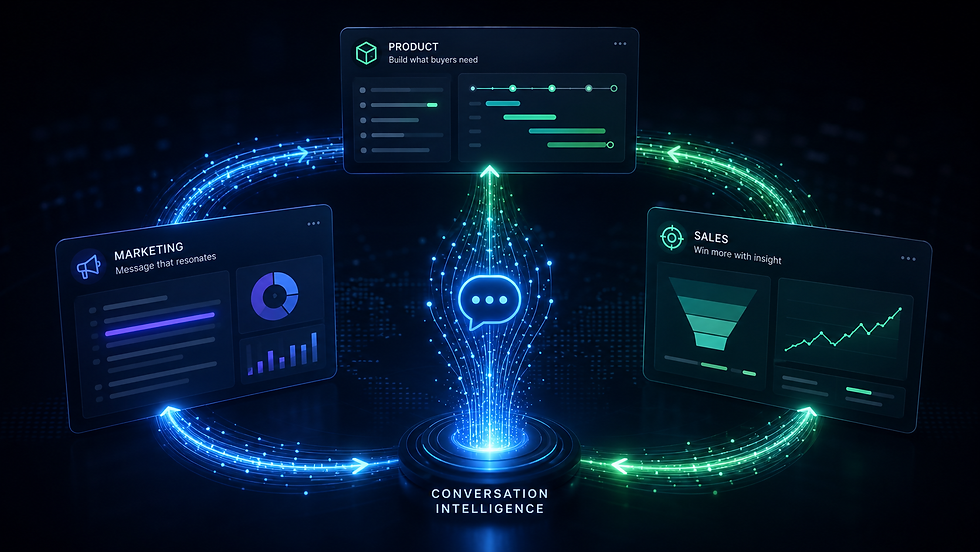
The real power is not any single application. It is what happens when marketing, product, and sales all draw from the same continuously updating intelligence stream.
Most organizations operate as three separate learning systems. Marketing learns from campaign performance. Product learns from customer feedback. Sales learns from deals. Each function gathers intelligence independently and shares only fragments with the others.
Conversation intelligence changes that dynamic. Marketing, product, and sales begin learning from the same source at the same time. A buyer objection discovered in a conversation can influence messaging, product priorities, and sales execution simultaneously. Intelligence no longer moves slowly between departments. It compounds across them.
The result is a learning system rather than a reporting system. Instead of generating periodic insights, it creates a continuously improving understanding of the market that becomes more valuable with every buyer conversation.
Strategic GTM Insight as a System
MYai Sells was built to make this system possible. Its Human AI captures buyer motivations, objections, and decision criteria in real time across every inbound interaction, turning every conversation into intelligence that continuously sharpens marketing messaging, product priorities, and sales strategy at once.
That is not just sales data.
It is a strategic GTM insight loop that gets sharper with every deal.
What would your GTM strategy look like if marketing, product, and sales all worked from the same intelligence?
See how MYai Sells turns every conversation into strategic GTM insight.
Strategic intelligence is only as valuable as a company's ability to act on it. The next question is not what this intelligence reveals, but how a company actually begins shifting its entire GTM model to capture and use it.



Comments